

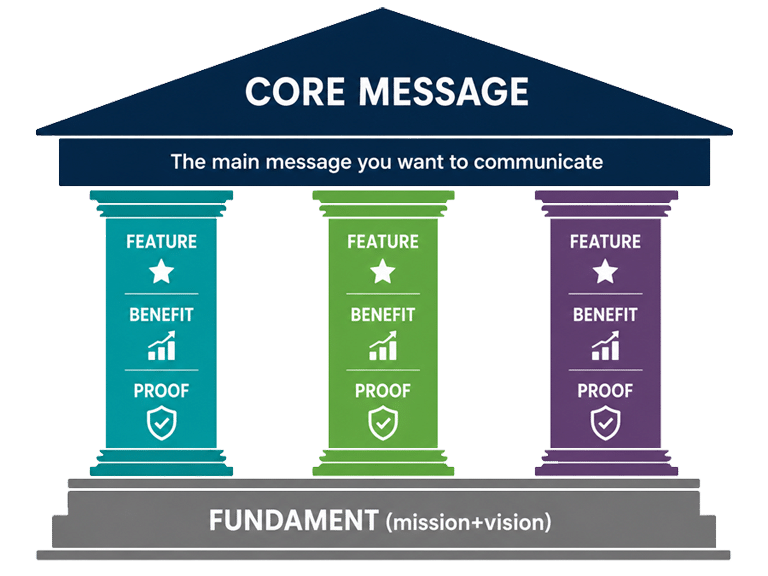
What Is a Message House?
You can tell countless stories about your topic, organization, or product. But not every story supports what you actually want people to remember. Some stories reinforce your core message. Others just create noise.
A Message House is a strategic framework that helps you decide which stories strengthen your message — and which ones don’t. It helps you choose what content deserves to be developed into clear “feature-benefit-proof” messaging, and what can be left out.
The Message House Structure
A classic Message House consists of three pillars, a foundation, and one overarching message.
The Roof: The Core Message
This is the main idea you want to communicate — the central takeaway of your story. Ideally, it can be summed up in a single sentence. Everything you say or write about the topic should connect back to this overarching message.
The Pillars
These are the supporting themes or smaller “feature-benefit-proof” messages that strengthen and give meaning to the core message.
The Foundation
This is what you and your organization fundamentally stand for. Strip everything else away: what is the true reason your company or organization exists?
Why Use a Message House?
Many companies focus mainly on goals, audiences, or channels. But if you want to stay top of mind with your audience, you need a clear position.
You might think: “Why would I need a core message and foundation for every topic? Isn’t it mainly about the content itself?” Partly, yes. You can absolutely start by filling the pillars of the Message House with separate topics. And chances are, there’s already plenty to say about all the different aspects of your subject.
But if you want your communication to be more persuasive and more memorable, it helps when all your content follows the same narrative thread. Otherwise, your audience won’t really understand what you stand for — and your key messages won’t stick.
So before creating content, define your core message first. After that, your foundation becomes a useful test: do your key messages truly align with the purpose, mission, and reason your company, organization, or team exists?
How to Build a Message House
Example
1. Core Message (The Roof)
“Sustainable business isn’t a cost — it’s the key to long-term success.”
2. Supporting Messages (The Pillars) with Proof
Sustainable business attracts customers and investors.
Evidence: 70% of consumers say they prefer buying from sustainable brands. (Source: Nielsen)
Companies that operate sustainably reduce costs over time.
Evidence: Organizations that implement energy-efficient measures save an average of 20% on energy costs. (Source: McKinsey)
Innovation and sustainability go hand in hand.
Evidence: 60% of companies investing in sustainability report higher productivity growth driven by innovation. (Source: Harvard Business Review)
3. The Foundation
Mission: We strive for a future where businesses thrive by embracing sustainability as a core value.
Vision: We believe sustainability and economic growth strengthen each other, and that responsible business practices will become the standard across every industry.
The Result
With this structure, your message becomes not only stronger and more media-friendly, but also better supported and aligned with your organization’s long-term goals.
“With these three steps, you can build a clear and powerful Message House. It ensures that all your key messages contribute to your overarching message and make your overall communication and positioning far more effective.”