

The American marketing expert Robert Cialdini shows that people make decisions based on instinctive mechanisms. In media and communication contexts, you can use this to tailor your message effectively to the individual or target audience.
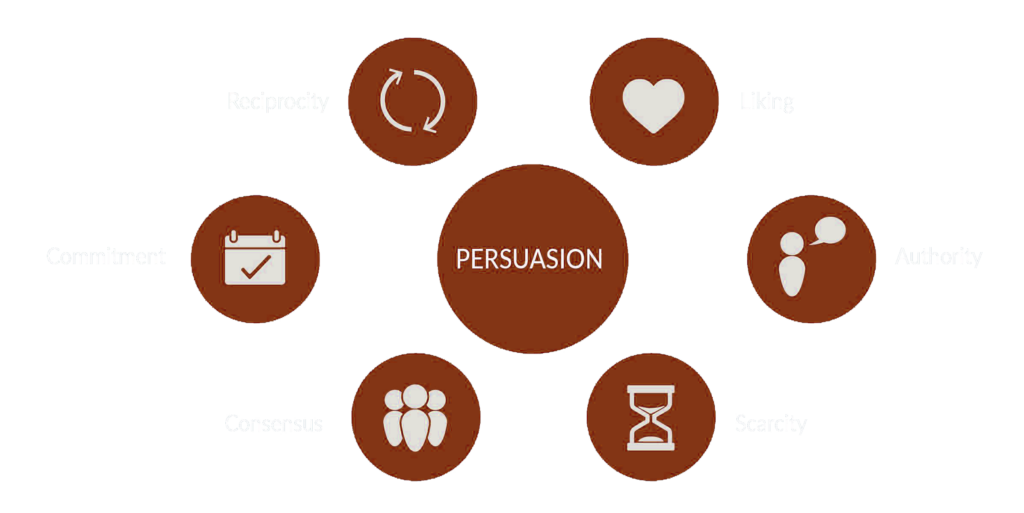
1. Reciprocity
The idea of “give and take” plays an unconscious role in our decision-making. When a company does something for us—even something small—we feel inclined to return the favor.
2. Consistency
People like to make choices that feel logical and aligned with their previous actions. Once a first step is taken, the next one often follows naturally. That’s why a chosen direction is rarely changed. Salespeople use this by asking a few questions that are easy to agree with, increasing the chances of a “yes” to the actual offer.
3. Consensus (Social Proof)
People are social creatures. Especially in uncertain situations, we tend to look at others and align our decisions with theirs. It reassures us that we’re making the right choice. Think of reviews, ratings, and likes.
4. Liking
We’re more easily influenced by people we like. We trust them more and are more open to their suggestions. Effective influencers build goodwill—for example, by giving genuine compliments.
5. Authority
Experts and well-known figures tend to be more persuasive than others. Simply put: people assume that authority figures are right. In practice, this is reinforced through things like quality labels or visual cues—someone in a white coat is quickly seen as a medical expert.
6. Commitment (Unity)
People have a strong need for connection and belonging. The most powerful form is family, which is why we often trust relatives more than outsiders. This effect also appears with shared backgrounds, similar ages, or common values and interests. It can even arise from being in the same place, like at a sports event or concert.
7. Scarcity
People are sensitive to the fear of missing out. Creating a sense of scarcity encourages quicker action. By tapping into that urgency or desire, people are more likely to make a purchase.
“When you communicate using Cialdini’s principles, you don’t push harder—you make it easier for people to say yes. You build trust faster and turn messages into actions by aligning with the needs of your counterpart. And that’s the key in how people naturally decide.”