
AUDIENCE FOCUS. THE FOUNDATION OF COMMUNICATION

Audience focus is the strategic ability to know exactly who you want to reach, why they should listen, and which message will actually stick with them. For spokespeople and advisors, it’s a core skill—especially in an era where you’re judged within five seconds, even before you’ve said a word.

Start with the “Why” (Simon Sinek)

You rarely get the time to tell the full story. So you need absolute clarity on who needs to know what—and why.

  • Why is your message relevant to this audience?
  • Which values and concerns matter to them?
  • What context do they need to understand your point?

Once that’s clear, your communication becomes focused, accessible, and—most importantly—recognizable. You’re no longer speaking “to everyone,” but to exactly the person who needs to hear you.

Understand the psychology of attention (Robert B. Cialdini)

Cialdini shows that people make decisions based on instinctive persuasion triggers. In media and communication, you can apply these—smartly and ethically:

  • Authority: Make it clear why you’re a credible source.
  • Consistency: Align with previous messaging; media dislike surprises (unless they’re good ones).
  • Social proof: Use examples, data, or cases to show your story is real and relevant.

Speak your audience’s language and world

A journalist has different needs than a city council member, activist, customer, or CEO.

Audience focus means you:

  • Adapt your tone of voice
  • Filter content for relevance
  • Sharpen your core message until it resonates with them

The difference between a powerful quote and an awkward soundbite? Usually: audience insight.

Make choices—dare not to serve everyone

A message aimed at everyone ultimately connects with no one.

Professionals in media and communication understand that segmentation doesn’t limit impact—it amplifies it:

  • Better-informed audiences
  • Less noise and misinterpretation
  • Stronger media performance
  • Higher chance of being quoted or picked up

Audience Focus Checklist for Media & Communication

1. Who is my primary audience?

  • Who am I speaking to today?
  • What’s their knowledge level?
  • What’s their stake, concern, or urgency?

2. Why does this matter to them?

  • What’s at stake?
  • Which problem, risk, or benefit directly affects them?
  • Which emotion is in play (uncertainty, anger, curiosity)?

3. What must they remember?

  • Define one clear umbrella message
  • Add one or two supporting points (fact, example, or consequence)

4. How do I show credibility?

  • State your role and expertise
  • Provide one clear proof point
  • Stay consistent with previous communication

5. Which psychological triggers apply?

  • Social proof: Can I show others relate or support this?
  • Reciprocity: Can I offer value (insight, nuance, direction)?
  • Urgency: Why does this matter now?

6. Does my language fit this audience?

  • Are my words instantly clear?
  • Is the pace appropriate?
  • Am I avoiding jargon and fluff?

7. How do I prevent misinterpretation?

  • Are my statements unambiguous?
  • Do I have clarifying phrases ready?
  • Do I know what I’m deliberately not saying?

8. Does my non-verbal communication align?

  • Posture: open, calm, confident
  • Facial expression: engaged, not exaggerated
  • Hands: visible and controlled (not launching a helicopter)

9. What could go wrong—and how do I handle it?

  • Tough questions prepared?
  • Core message ready under pressure?
  • Clear boundaries in place?

10. What should this audience do next?

  • Understand?
  • Act?
  • Support?
  • Wait?
  • Share?

Make this explicit—otherwise your message ends up in the category: “Nice story… now what?”

STRUCTURE YOUR PITCH

A pitch without structure is just noise with good intentions. The Feature → Benefit → Proof flow fixes that by matching how people actually make decisions.

PERFECT PITCH FAMEWORK

Feature — what it is
Start with the facts. What are you offering? Keep it concrete and specific. This gives your listener something to hold onto.

Benefit — why it matters
Translate the feature into value for them. Not what it does, but what it changes. Saves time, reduces risk, increases revenue, makes life easier — pick the one that hits their context.

Proof — why they should believe you
Claims are cheap. Back it up with evidence: numbers, results, case studies, testimonials, demos. This is where skepticism drops.

Why this works:

  • It moves from objective → personal → credible
  • It answers the three silent questions in your listener’s head: What is it?Why should I care?Can I trust this?
  • It prevents the two classic mistakes: listing features with no relevance, or making bold claims with no evidence

Quick example:

  • Feature: “Our tool automates customer follow-ups.”
  • Benefit: “So your team saves hours every week and no lead slips through.”
  • Proof: “Teams like X cut response time by 40% within a month.”

Clean, logical, persuasive. That’s the point.

Why does an example matter?

A core message without an example isn’t complete. People are wired to respond to images, not just statements. Most people don’t just think in images — they process in images too. And it starts with the picture you, as a speaker, create through what you show and say in your presentation.

Use that. Let the image carry your story and instantly give meaning to the point you want to make.

An example:

Confession
I loved you with a love so deep and true,
that now I’ve almost lost all thought of you,
yet speaking still your name remains with me
a gentle touch I live on endlessly.

And this the sweetest memory I keep:
how in the square, where linden songs ran deep,
from shaded streets of white you came my way.
Soft summer winds at play

pressed silk of pale yellow against your frame,
your slender form, your eyes — a wistful flame,
wide with a longing, distant, undefined.
How many summers slipped behind.

I loved you still with such enduring grace,
that now I’ve almost lost your form, your face,
yet on my lips there lingers, soft as when,
I speak your name alone… and live again.

© 1946 – Hans Warren

I SEE WHAT YOU MEAN

This reflection by the Dutch poet Hans Warren is one of my personal favorites — mainly because I can see it. Generally speaking, people remember about 80% of what they see, 20% of what they read, and just 10% of what they hear. He combines all of that, turning this poem into something you don’t just understand — you feel.

Now imagine what happens when you combine seeing, hearing, and “reading” in your presentation or in an answer to a journalist’s question. Suddenly, you’re quotable. Journalists — and their viewers, listeners, and readers — love vivid imagery.

That’s why, after “what’s going on?”, the most common journalistic question is: “what does this look like in practice?”
In other words: example…?

Speelse zomerwinden interpretatie

PITFALLS

A common mistake in presentations is forcing in visuals that add no value. Picture a speaker at a livestock conference showing a slide of a cow and saying, “this is a cow.” Not helpful.

In presentation training, we teach you to make visuals work for you — to strengthen your message. Don’t tell people what they’re seeing. Tell them why it matters. For example: “This is Bertha 76, our award-winning dairy cow.”

Another pitfall is interpretation through your own mental frame — or “denkraam,” as Olivier B. Bommel would put it. The image I have in mind when reading Warren’s poem is personal: a memory of my high school crush Carolina, walking through a golden field. Someone else might picture a completely different scene — say, a man strolling along a seaside boulevard. In that case, my image might distract rather than clarify.

VISUAL PROCESSING IS FASTER

Research shows that over 90% of the information our brains absorb is visual. And it’s not just about what we see around us — it also applies to the information we hear or read. Visual content is processed up to 60,000 times faster than abstract or theoretical information.

So don’t aim to be exhaustive. Aim to be meaningful. Bring your core message to life with an example tailored to your audience.

That’s where understanding turns into impact.

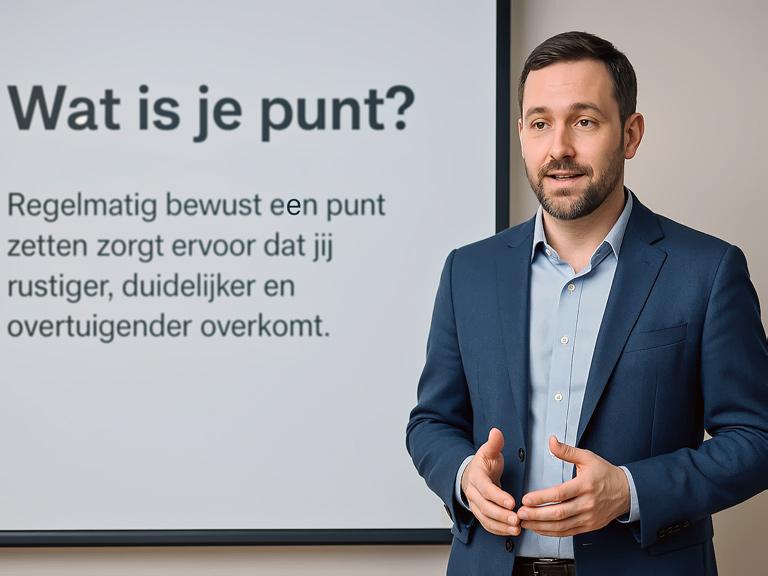
What’s your point?

“If you don’t put a period after the point you just made, then you didn’t really make a point.”

A well-placed period — in your words and in a brief (half-second) pause — gives your message strength and direction. It says: “This is what I mean.” No more, no less.

The effect? Your listener can hear when something matters. And they get a moment to process what you just said. It makes your story easier to follow. A completed thought gives them space to absorb your words, reflect, and respond if they want to.

Without pauses or clear endings, listeners fall behind. They have to listen and guess at the same time — trying to figure out where you’re going.

Especially when you have a lot to say, consciously placing your “periods” is a powerful way to keep things concise and on point.

Close your mouth (for one second)

At the start of every new idea in your presentation — or at the beginning of an answer — deliberately close your mouth for a second. It puts you in “period mode.”

Then make it a habit: drive each key sentence or paragraph toward a clear ending, followed by a brief pause with your mouth closed. Your audience will thank you for it.

Why using a period works:

🔹 For you:
– You sound confident and in control
– Your message stays clear
– You avoid rambling

🔹 For your listener:
– You’re easier to follow
– There’s space to process
– The core message lands better

Presentatietraining kort en bondig spreken.

Example:

Without a period:
“We should call the customer back faster… and the CRM… and the newsletter…”
– Vague. Overloaded. No action.

With a period:
“We need to call the customer back faster. Period.”
– Clear. Focused. Actionable.

💡 Tip:
Pause every now and then.
– A short silence is a period too.

A period isn’t an ending — it’s an anchor.

For you, to speak with impact.
For your listener, to actually keep up.